South Africa’s elephant strategy rightly celebrates heritage, culture and coexistence. But it’s proposals for adaptive management and flexibility could threaten what protection elephants actually receive.
South Africa’s new National Elephant Heritage Strategy, published last month, asks the country to think about elephants as part of a national inheritance, woven into ecology, culture, spirituality, livelihoods and the country’s future.
It covers the years 2026 to 2036 and provides guidance for managing all elephants as a collective national herd, including conservation, cultural values, economic opportunities and responsible use.
The strategy is intended to guide policy, including the Elephant Norms and Standards, the National Elephant Research Strategy, reserve-level Elephant Management Plans and national elephant meta-population guidelines.
Its vision is broad: “Resilient elephant populations help nature thrive, support cultural and spiritual traditions and give South Africans fair and inclusive chances to live well now and in the future.”
It’s carefully aligned with the White Paper on the Conservation and Sustainable Use of South Africa’s Biodiversity as well as the National Biodiversity Economy Strategy.
There is a problem, however. The strategy attempts to hold together two things that may be irreconcilable: elephants as sentient beings with social lives, and elephants as a resource for economic benefit.
Current concerns
The introduction of the strategy comes at a time of mounting controversy over the proposals to cull 1,220 elephants in KwaZulu-Natal reserves, and also a substantial number in Madikwe in North West province. However neither proposal is supported by publicly available peer reviewed research.
According to testimony presented to Parliament, a long-term preventive measure – immunocontraception – was offered at no cost to Madikwe as far back as 2020. However, after bureaucratic delays, an MOU was only eventually signed with the NGO Humane World for Animals in 2024. But it was never implemented. This delay has resulted in the avoidable births of 300-400 elephants.
Revised Elephant Norms and Standards were gazetted in 2023/24 after an extensive and exemplary public participation process but were withdrawn due to the court challenge by wildlife breeders of the term “wellbeing” in the National Environmental Management: Biodiversity Act.
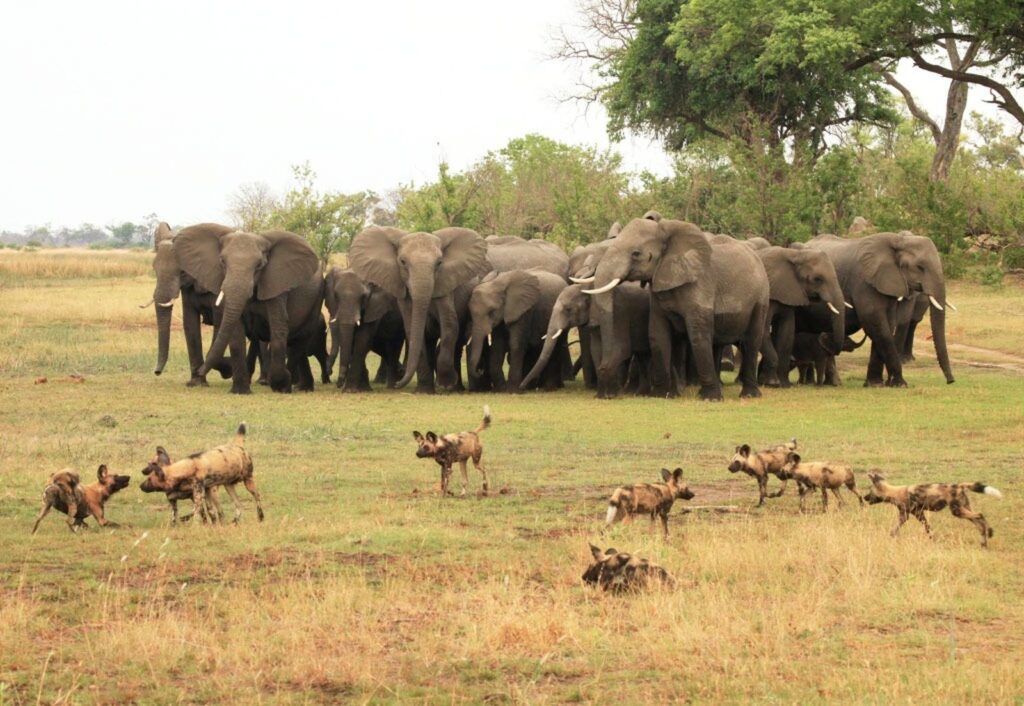
Like us, elephants fiercely defend their young from danger. (Photo: Francis Garrard).
The Revised Elephant Norms and Standards are now being revised again by an internal committee within the Department of Forestry, Fisheries and the Environment without the requisite public participation. MP Andrew de Blocq requested details of the composition of this committee, but these had not been supplied by time of publication.
Professor Rob Slotow, an elephant specialist closely involved in drafting and facilitating much of the strategy, says the heritage document itself is strong. Its value, he says, lies in the way it foregrounds the many dimensions of elephant conservation: not only biology, but people, economics, politics, social value, spiritual value and cultural value.
But he warns that the strategy can be undermined by how it is used.
“The danger is that officials, managers or interest groups select the parts that support what they already want to do, then claim alignment without applying its full logic.”
According to Slotow, the language of “flexibility” in revising the norms and standards may in practice mean weakening or removing the wellbeing principles that currently constrain elephant management.
The EMS Foundation amplified this concern, saying it is “deeply concerned that SA’s National Elephant Heritage Strategy fails to recognise elephants as sentient beings with intrinsic value, and instead continues to frame them primarily through a utilitarian lens as assets within a biodiversity economy”.
That contradiction
Conservation is generally most comfortable with what can be counted: animals, hectares, fences, permits, populations, trophy income, tourism income and quotas. The heritage strategy asks to widen that frame to what elephants mean to people, how they shape landscapes and how benefits can be shared more fairly.
But this sits alongside management tools: water and fire management, fencing, translocation, contraception and, in some cases, culling. The existing Elephant Norms and Standards begin with non-lethal approaches before moving toward more interventionist or lethal options when earlier steps are not feasible.
The danger, Slotow argues, lies not in the strategy itself but in operational documents now forming around it, including development of meta-population guidelines and revision of the norms and standards without further public participation.
His concern is that non-statutory documents, which may not go through the same level of public consultation, can gain legitimacy by being linked back to the heritage strategy.
The controversial Elephant Indaba – dominated by wildlife breeders and hunters – is, for him, a revealing example. He says although it did not shape the heritage strategy in any substantive way, material about the Indaba was inserted into the consultation section after the fact and will directly influence its application.
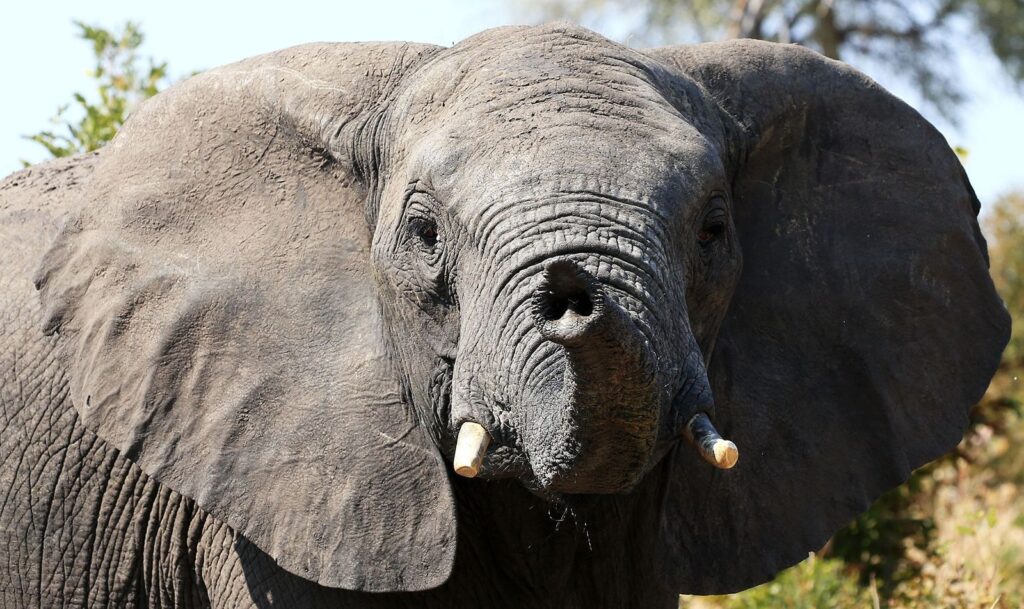
There is ongoing legal contestation about the inclusion of the term ‘wellbeing’ in legislation. (Photo: Colin Bell)
The insertion implies, erroneously, that they went through a proper public consultation process, making them a legitimate part of the strategy. This is an attempt to integrate indaba actions into existing tools or projects, implement culling when flexible ecological limits are exceeded, and integrate flexible ecological limits in problem animal management plans, he says.
Undermining the strategy in these ways, Slotow says, would be a tragedy because it is good legislation.
In Parliament, De Blocq also voiced his concern.
“I don’t think it constitutes a proper public participation process in the true, intended sense as laid out in the Promotion of Administrative Justice Act, which governs how this crucial process should be executed.”
Elephant numbers
By the end of 2024, the country had about 44,000 African savanna elephants, and the population continues to grow. Local concerns are habitat fragmentation, small isolated populations and habitat loss. Is there a solution?
The strategy’s answer is to create “living landscapes”, places where people and nature live and grow together. These may include protected areas, farms, tourism landscapes, community-owned land and corridors that allow movement.
It’s an ambitious idea, but on the ground there will be massive logistical challenges. If elephants are fenced, moved, contracepted, hunted, culled, supplied with water, denied access to water, or killed as damage-causing animals, coexistence must be matched by strict ethical tests.
The wellbeing case points to what those tests might involve. A wellbeing requirement in biodiversity law would influence permits, norms and standards, management plans and policy choices before harm occurs. It changes the frame from punishment after cruelty to prevention, assessment and accountability.
The concern is that the heritage strategy may be too vague. It speaks of sustainable use, benefit sharing and inclusive development. But sustainable use is not self-explanatory. Who uses? Who benefits? Who carries the risk? Who decides? And where, in that chain of value, does the animal’s own experience sit?
Slotow’s warning is that currently protecting elephants as sentient animals sits most clearly in the norms and standards. If those principles are weakened, or shifted into softer guidelines, they may effectively disappear from the machinery of elephant management. That’s why wellbeing is important.
The wellbeing question
SA is still waiting for clarity from the Constitutional Court on the legal status of animal “wellbeing”. In that case, the NSPCA and EMS Foundation are defending the inclusion of the definition of animal wellbeing in the National Environmental Management: Biodiversity Act after the Department of Forestry, Fisheries and the Environment inexplicably abandoned the case.
The challenge was brought by the South African Hunters and Game Conservation Association, which argues there was insufficient public participation before the definition of wellbeing was inserted. Their subtext of their objection is that wellbeing could challenge trophy hunting.
In the National Environmental Management: Biodiversity Act, wellbeing is defined as the “holistic circumstances and conditions of an animal that support its physical, physiological and mental health and quality of life, including its ability to cope with its environment”.
It would no longer be enough to ask whether a population is viable, whether a reserve is overstocked, whether a species is protected, or whether an activity can be justified as sustainable use. It also asks what is happening to the animal itself.
This is especially important for elephants. The heritage strategy recognises that elephants are sentient, conscious and highly social animals with family units, social dependencies and coping strategies. It says elephant management interventions should be embedded within a principle of duty of care.
But until SA settles what animal wellbeing means in law, and until that meaning is protected in the rules that guide management, the heritage strategy has a built-in weakness. It asks the country to honour elephants but does not put in place the mechanism for protecting them as individuals.
The real test will be whether its implementation notices the animal inside the policy.
Original source: https://www.dailymaverick.co.za/article/2026-06-22-will-sas-new-elephant-strategy-truly-safeguard-their-future/
